alex@810lab.com
Intro
For a linear vector manifold, the exponential of the differential, $e^{\tau \partial_a}$, implements a translation in the independent variable when operating on a function $f$. $$e^{\tau \partial_a}f = f(x+\tau a) $$
for a small $\tau$. Since translations commute,
$$ f(x+\tau a +\epsilon b) = e^{\tau \partial_a+\epsilon \partial_{b}}\stackrel{?}{=} e^{\tau \partial_a}e^{\epsilon \partial_{b}} $$
Again, reverse the logic and assume the product of exponentials is true in general,
$$e^{\tau \partial_a}e^{\epsilon \partial_{b}} \stackrel{?}{=} e^{\tau \partial_a+\epsilon \partial_{b}} $$
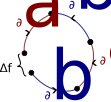
This is true when $\tau$ and $\epsilon$ are small, but small compared to what? Compared to the curvature. This is what we are assuming by a linear vector manifold. One way to measure curvature, would be to move along $a$ then $b$, then back along $-a$ then $-b$. Basically reverse your steps in a different order to get back to the start.
 \begin{align*}
\Delta f &= e^{-\tau \partial_a}e^{-\epsilon \partial_b}e^{\tau \partial_a}e^{\epsilon \partial_b}f -f\\
&=( e^{-\tau \partial_a}e^{-\epsilon \partial_b}e^{\tau \partial_a}e^{\epsilon \partial_b}-1)f\\
&= (R\tilde{R} -1)f \\
\end{align*}
\begin{align*}
\Delta f &= e^{-\tau \partial_a}e^{-\epsilon \partial_b}e^{\tau \partial_a}e^{\epsilon \partial_b}f -f\\
&=( e^{-\tau \partial_a}e^{-\epsilon \partial_b}e^{\tau \partial_a}e^{\epsilon \partial_b}-1)f\\
&= (R\tilde{R} -1)f \\
\end{align*}
Another method is to compare the difference in $f$ at some nearby point, going either way .
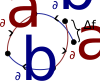
\begin{align*} \Delta f &= e^{\tau \partial_a}e^{\epsilon \partial_b}f -e^{\epsilon \partial_b}e^{\tau \partial_a}f \\ &= (R -\tilde R )f \end{align*}
Lets see if we can re-work this in terms of conjugation, because conjugation is dank. $$ e^{\tau \partial_a}e^{\epsilon \partial_b} fe^{\tilde{\epsilon \partial_b}}e^{\tilde{\tau \partial_a}} =f(x+\tau a +\epsilon b -\epsilon b -\tau a ) =f(x) $$ which is a dumb thing to write when we are in a linear space.
Scalar Curvature
This section discusses scalar curvature using a non-standard convention for the differential. it is likely not of use.
The forward differential in the a-direction $ \partial_a $ applied to a function $f$ over a linear manifold is defined by
\begin{align} \partial_a f &\equiv \frac{f(x+\tau a )- f(x)}{\tau} \\ \end{align}
Consider defining the backward differential with a reverse symmetry,
\begin{align}
\ f \partial_a &\equiv \frac{f(x)-f(x-\tau a )}{\tau} \\
\end{align}
The central differential is then seen as an inner product
\begin{align} \partial_a \cdot f \equiv \frac{1}{2}(\partial_a f + f\partial_a ) =\frac{ f(x+\tau a ) - f(x-\tau a )}{2\tau} \end{align} The second order central differential is
\begin{align} \partial_a \wedge f \equiv \frac{1}{2}(\partial_a f - f\partial_a ) = \frac{f(x+\tau a ) -2f(x)+ f(x-\tau a )}{2 \tau} \end{align} Note that these operations are all grade-perserving, so the usuall interpretation of the inner/outer product as grade changing is not sustained. what is \begin{align} \partial_a f \partial_a \\ \end{align}
the conjugation gives
\begin{align} e^{\tau \partial_a} fe^{-\tau \partial_a} &=T_{\tau a}f \tilde T_{\tau a} \end{align}
Exponetial of a Differential
\begin{align} \partial_a f &\equiv \frac{f(x+\tau a )- f(x)}{\tau} \\ \partial_a f&= \frac{1}{\tau}(T_{\tau a}-1)f \\ 1+ \tau \partial_a &= T_{\tau a} \\ e^{\tau \partial_a} &=T_{\tau a} \end{align}
The backward differential $ \partial_a $ is
\begin{align}
\ f \partial_a &\equiv \frac{f(x)-f(x-\tau a )}{\tau}
\\
f \partial_a &= f (1-T_{-\tau a})\frac{1}{\tau} \\
1- \tau \partial_a &=T_{-\tau a}\\
e^{-\tau \partial_a} &=\tilde T_{\tau a}
\end{align}
Domain vs Range
how do we know if an operator will operator on the range of domain.
For example take $f = x^2$ $$T_a f(x) = f(x)+a = x^2 +a $$
or
$$T_a f(x) = f(x+a) = (x+a)^2 $$
Rotations vs Translations
Given that we defined the a-derivative applied to $f$ as, $$ \partial_a f \equiv \frac{f(x+\tau a )- f(x)}{\tau} = \frac{1}{\tau}(T_{\tau a}-1)f $$
Where $T$ is the translation operator. If we want to make a large translation, $a$ , we could add up many small translations.
$$ T_a = \prod (T_{\tau a})^{\frac{1}{\tau}} = (e^{ \tau \partial_a })^\frac{1}{\tau} = e^{ \partial_a }$$ Maybe the use of translation in the differential could be extended to rotations. so the finite diff would become a finite div.
$$e^{\tau \partial_B} =R_{\tau B} $$
where B is a bivector. Then we get
$$ \nabla = \sum B \partial_B $$ $$ \nabla = e^{B \tau \partial_B} =R_{\tau B} $$ The geometric derivative is then
Ortho-not-Normal
Curvature on a sphere
from kingdon import Algebra, calculus
from kingdon.numerical import exp  as exp_
exp = lambda x: exp_(x,n=50) # precision control of exp

pga = Algebra(3,0,1,start_index=0)
locals().update(pga.blades)

f = lambda x:3*x
x= pga.random_vector()
f(x)
lambda f,a: f+da(f,a)
<function __main__.<lambda>(f, a)>